
§ 01 · Matsi

An agentic platform for advanced material discovery & formulation

A datasheet gives you numbers. Matsi uses those numbers to create materials, flipping the script and allowing users to choose from cleaner options that lead to the same properties. A single formula took 18 months to develop and test. Matsi needs 18 minutes.
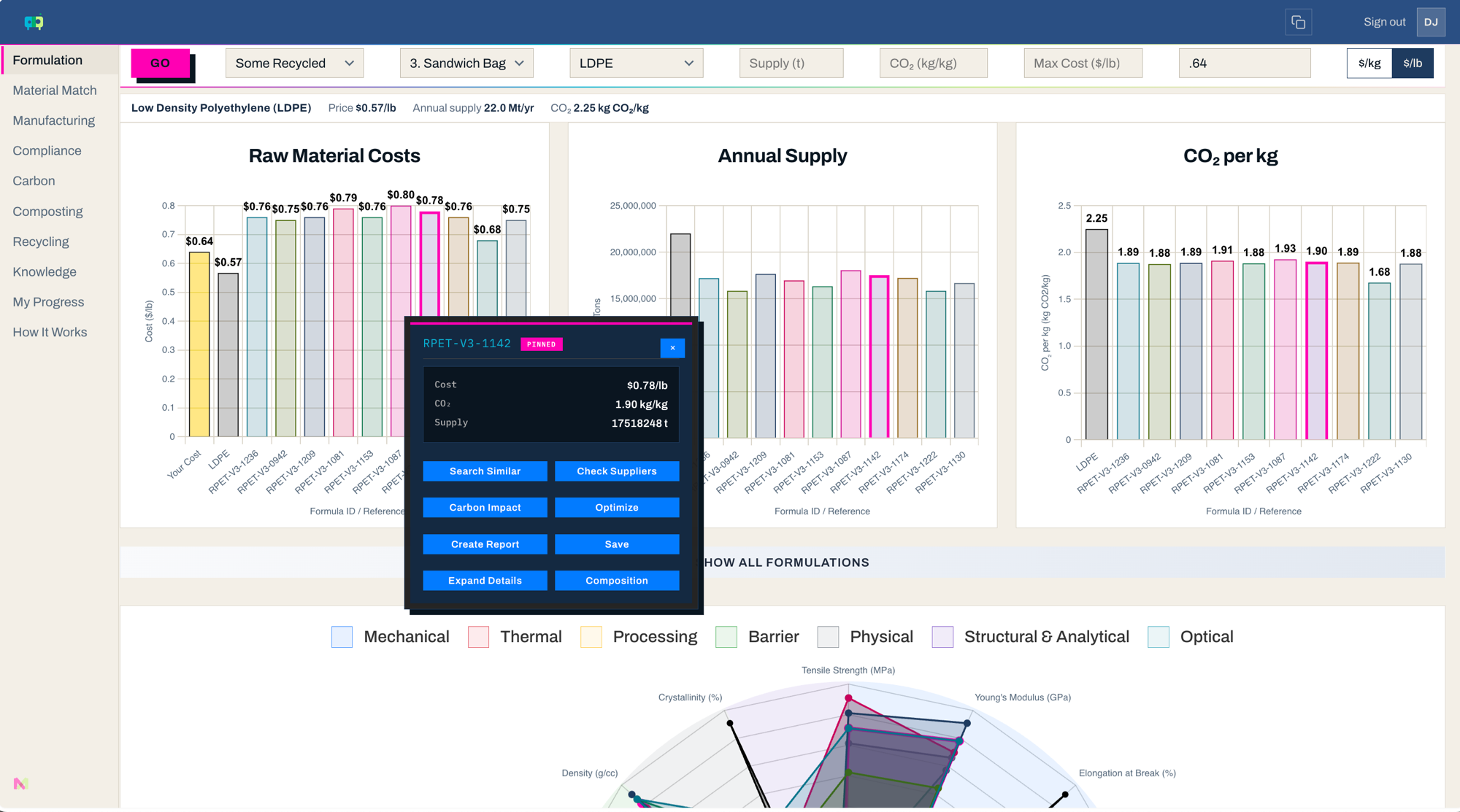
The Matsi formulation workspace. The brief is set across the top as recycled content, application, base polymer, supply, carbon and cost ceiling. Candidate formulations are compared on raw material cost, annual supply and CO2 per kg against the incumbent. One candidate is pinned, showing its cost, carbon and available supply alongside next actions. A property radar sits beneath.
The formulation workspace. The brief is set as constraints across the top, and candidates come back compared on cost, supply and carbon against the incumbent. Pinning one shows its figures and what can be done with it next. The full property profile sits underneath. Matsi formulation dashboard.

§ 02 · The reversal

When a CPG brand or a packaging supplier swaps out a legacy petrochemical grade, they start with a performance target, not a recipe. Matsi turns that target into a search with a hard gate on every one of these:

Impact strength
Izod at 23 °C and −20 °C · ISO 180 / ASTM D256
Thermal stability
HDT at 0.45 MPa · ISO 75 / ASTM D648
Rheology & flow
MFI at 230 °C / 2.16 kg, PP basis · ISO 1133 / ASTM D1238
Stiffness
Tensile and flexural modulus · ISO 527 / ASTM D790
Non-negotiables
Bio-content targets, regulatory flags such as EU PPWR and California SB 54, and a unit-cost parity ceiling
spec sheet formulation

§ 03 · Matched Compatibility Why blending is not a recipe search Incompatible polymers won\u2019t stay mixed. Inside the extruder they separate into micro-phases and the part delaminates. Compatibility belongs to the pair, not to either polymer on its own, which is why you can\u2019t read it off either datasheet.

Blending two polymers doesn't give you the average of their properties. Treat formulation as a search over ratios and you'll get confident suggestions for blends that can't physically exist. That's the trap with machine learning in chemistry, so it's the first thing we check. Candidate ingredient streams go through a thermodynamic compatibility check before any property is predicted. The engine evaluates phase morphology and screens for the compatibilisers that would be required (PP-g-MAH, PLA-g-MAH) to get interface adhesion. A ratio that violates mixing physics is discarded mathematically, before anyone weighs out a gram of resin.

phase-separated bonded

§ 04 · The loop Closed loop Most tools predict once and stop. Matsi runs a cycle: propose candidates, predict their properties, score them against your target, feed the scores back, and propose better ones. It keeps going until the target is met or it runs out of iterations, which is why it can search a space far too large to enumerate.

Target properties & constraints 01 Generate candidates DOE + Bayesian search Guardrails applied first 02 Predict properties Physics / empirical hybrid Mechanical, thermal, flow 03 Evaluate Scored against target Feasibility checked 04 Optimize Scores return to optimiser Better candidates proposed target met? no, iterate yes Ranked candidates, ready for testing

Key innovation. Hundreds of candidates are generated and evaluated computationally, with properties predicted before any physical testing. That is where the development time and material cost come out.

§ 05 · The search space

A brief never names a recipe, so we have to search every lever that could move the spec. Sustainability and compliance rules cut the pool down before anything gets proposed, so you never see a candidate that could never have qualified anyway.

What the search covers resins · modifiers · fillers · process
Base resins
24 polymers: recycled and virgin commodity grades, bio-based and compostable chemistries, and engineering resins up to PEEK.
Impact modifiers
Elastomers and functionalised rubbers.
Compatibilisers & interface agents
The grafted polymers that bond immiscible phases, plus plasticisers and nucleating agents.
Reinforcements and fillers
Mineral, fibrous and bio-derived.
Stabiliser packages
Antioxidants and UV absorbers.
Process settings
The extrusion and conversion parameters that go with the recipe.
candidates evaluated

§ 06 · Our Models

Predictions are only as good as the data used to make them. Our models are calibrated against 36,917 published lab measurements where we ensure property, polymer, and processing are tracked. Top formulation candidates can be moved on to physical validation via compounding and conversion into a final product. Measurements from these specimens join the same dataset, and anchor the next predictions. Our models are improving daily and we track which properties we predict well and the ones we still struggle with, and we’re transparent about it.

§ 07 · What a run returns

Every run gives you a ranked set, best first, and each score comes with the reasoning behind it. There's no single number to take on faith.

ranked, best first
Ranked candidates, predictions, plots, reports 6 outputs
  • Ranked candidates with full composition and process parameters
  • Predicted properties for every candidate
  • Evaluation reports with the agent's reasoning and scores
  • Convergence plots showing progress across iterations
  • Partial-dependence plots identifying the dominant performance drivers
  • JSON summaries with best-performing candidates and run metadata
Corpus · 2026-08-22
polymers modelled24
individual ingredients modelled103
— of a catalogue of117
ingredient types27
properties predicted per material19
material–property models444
— backed by measured data178
research documents held13,545
— read and mined10,692
measurements collected36,917
— tied to a known material27,726
formulations evaluated1.64M
recipes live on the dashboard9,394
— carrying model version and evidence100%
Batch run · stf-run-20260528T033824
candidates evaluated150
properties per candidate16
plus cost & carbon2
batch wall clock (n=8)43.5 min
throughput, parallelised3.4 / min

Run stf-run-20260528T033824 · figures measured 2026-08-21

Figures from a real run. Calibration is uneven across properties and we say so before a search starts, rather than after.

§ 08 · Capabilities

Guardrails, hybrid modelling, optimisation, reporting 6 capabilities
Sustainability guardrails
Recyclability, compostability, bio-content and mass-balance certification are treated as our prime directives.
Hybrid modelling
Physics-based rules combined with empirical data, across diverse formulation types.
Agentic evaluation
Feasibility, compatibility and performance assessed with stated reasoning for each score.
Bayesian optimisation
Learns from previous evaluations, converging faster than a sweep of the same space.
Automated reporting
Convergence and partial-dependence plots, and run summaries, generated for every campaign.
Failure handling
If we can’t evaluate a candidate properly, we say so rather than scoring it on half the information.

§ 09 · The result

Match a petrochemical performance spec, on the production assets you already have, without re-tooling the factory. Plenty of tools will hand you a clever answer. What we care about is handing you one you can actually run on Monday.

Request a demo